Beach Buggy Racing 2
- 4.5
- Rating
- 100.00M
- Installs
- Free
- Price
 Analysis by App-foxy
Beach Buggy Racing 2 is the kind of racing game I can open for a few minutes and understand immediately, yet it still gives me reasons to keep improving after the first easy races. It is a free kart-racing game from Vector Unit, built around bright tracks, playful collisions, and exaggerated physics rather than serious motorsport simulation. The tone is light, quick, and deliberately mischievous.
My first impression was that it wants to be approachable before it wants to be demanding. You do not need to know racing terminology, tune a realistic vehicle, or learn a complicated control scheme before reaching the track. That makes it a comfortable choice for a first-time player, especially someone looking for short bursts of entertainment on Android or iOS rather than a long, technical driving session.
The game is rated for Everyone, and that matches its presentation. The action is cartoon-like, the races are easy to read, and the humor keeps defeats from feeling too serious. At the same time, the kart handling has enough bounce and unpredictability to create mistakes that are genuinely funny one moment and surprisingly frustrating the next. The best way to approach it is as arcade racing with personality, not as a realistic driving test.
You May Also Like

 Pandora - Music & Podcasts
Pandora’s Music Is Easy to Start, but Harder to Recover
Pandora’s strength is its low-effort path from a seed to a station. Its weak spot is how much confidence it asks you to place in connection, setup, and quiet recovery.

 8 Ball Pool
 Is Built on Rivalries, Rematches, and Routine
A close look at the rivalries, rematches, shared routines, and unanswered safety questions that turn a quick pool match into a persistent mobile community.

 Samsung Music
’s Quiet Strength Is Playing What You Already Own
Its reach comes less from spectacle than from dependable access to a personal library. That simplicity is both the app’s strongest retention engine and its ceiling.

 AccuWeather: Weather Radar
AccuWeather Review: A Quick, Clear Forecast for Everyday Decisions
For everyday plans, the best forecast is the one you can understand quickly. AccuWeather makes rain timing, radar, and local conditions easy to act on, with a few trade-offs.

 Hill Climb Racing
Why Hill Climb Racing Still Turns Crashes Into One More Run
A tiny car, a bumpy hill and one more upgrade: Hill Climb Racing keeps resurfacing because its simple chaos makes every near-miss feel personal.

 AliExpress - Shopping App
AliExpress Makes Global Shopping Feel Personal, but Shoppers Bear the Risk
AliExpress turns a global marketplace into a pocket-sized discovery engine. Its reach is useful, its shopping loop compelling, and its trade-offs easy to miss.
More From Our News Desk
View All News


Getting from the first launch to a satisfying race
I start by treating the opening races as a chance to learn the track, not as a test I have to win immediately. Once I can guide the kart through a corner without overcorrecting, the racing feels much less chaotic and a clean finish becomes a satisfying first milestone. From there, I can focus on the small decisions that make later races more rewarding.
What to expect when you begin
The opening experience is designed to get me moving quickly. I do not spend the first session buried in menus or adjusting a long list of technical settings. The important early task is simply learning how the kart responds, how corners feel, and how the game’s unusual physics affect contact with other racers and the edges of the course.
That physics model is central to the appeal. Karts can feel lively, and small mistakes can have bigger consequences than they would in a conventional top-down racer. A collision is not always just a loss of speed; it can change my line, throw off a turn, or create an opening for another driver. I found that the most reliable early habit was to brake before a corner instead of trying to correct a poor approach halfway through it.
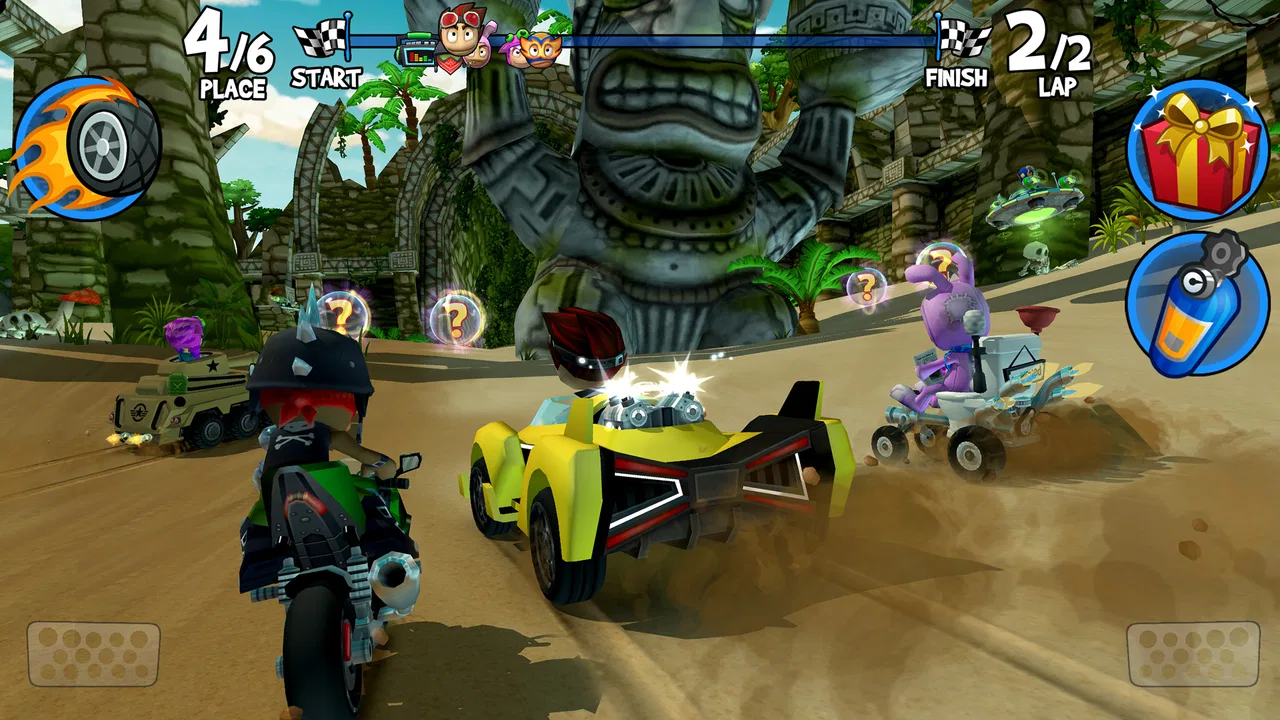
The tracks are built to be visually memorable rather than plain stretches of asphalt. Curves, obstacles, jumps, and changes in elevation make it important to look beyond the kart directly in front of me. I learned more by watching the road surface and the next bend than by staring at my current position. That is useful advice for beginners because the game’s colorful presentation can otherwise distract from the racing line.
Its store summary describes action-packed kart racing with humorous physics, and that is a fair description of the experience without explaining everything that makes it enjoyable. The humor is not separate from the driving. It comes through in the way vehicles react, how races can suddenly turn around, and how a clean lead can disappear after one badly judged corner.
A simple first setup that avoids early frustration
When I first start a mobile racing game, I want to know whether I should use touch controls, tilt controls, or an external controller. With this game, I recommend beginning with the default touch arrangement and playing several races before deciding that the controls are the problem. Early losses often come from unfamiliar timing rather than a genuinely poor control method.
Use the first session to answer three practical questions: can you steer smoothly through a medium corner, can you recover after touching a barrier, and can you keep your attention on the road while using any available race actions? If the answer is no, changing several settings at once will make it harder to identify what needs practice. Adjust one thing, then test it over a complete race.
I also suggest playing with the sound at a comfortable level. Audio cues can help me notice impacts and the rhythm of a race, but the visual route remains more important. If you are playing in a noisy place, the game is still understandable, though you may miss some of the atmosphere that makes the races feel lively.
Because it is free to download, the barrier to trying it is low. The trade-off is that optional in-app purchases range from $0.99 to $99.99 per item. I would not spend anything during the opening session. First learn whether the driving itself suits you, then decide whether any optional purchase improves your experience rather than using money to compensate for unfamiliar controls.
The first meaningful success is not simply finishing first
A new player may naturally treat victory as the only useful result, but I found a better early target: complete a race while taking the same corner cleanly several times. That small goal teaches more than chasing a position through reckless shortcuts. Once I can enter a bend at a controlled speed, steer without overcorrecting, and leave enough room to avoid a collision, finishing near the front becomes much more realistic.
My recommended first routine is straightforward. Begin by watching the track for one full lap instead of trying to overtake everyone immediately. Notice where the road tightens, where a jump changes your landing position, and where another kart tends to block the obvious line. On the next lap, focus on one section. This turns a busy race into a series of manageable decisions.
Another useful habit is to leave a little space when approaching a group of karts. In a more serious racing game, following closely can prepare an overtake. Here, the same move can put me into a chain of bumps that costs more time than it saves. Waiting half a second for the group to spread often creates a safer and faster opportunity.
That is one of the game’s less obvious lessons: speed is not always the same as progress. A player who repeatedly crashes while trying to force a pass may feel slower than someone who takes a cautious line and finishes consistently. For a first meaningful success, consistency is more valuable than a dramatic comeback.
How the physics change the way I drive
The kart behavior rewards anticipation. If I turn too late, a quick correction may send me into another racer or toward the outside of the course. If I turn too early, I may lose the inside line and give away space. The right response is usually smaller than I expect: moderate steering, a controlled approach, and patience while the kart settles.
Jumps deserve special attention. They look like opportunities to gain time, but the landing can determine whether the next corner is comfortable or chaotic. I try to think of the jump as part of the following turn, not as an isolated stunt. A landing that points the kart in the right direction is often more valuable than a flashy leap that leaves me needing to recover.
Collisions also require a different mindset from traditional racing games. I do not assume every contact is avoidable, especially in a crowded section. Instead, I try to protect my exit from the corner. If a bump is likely, keeping the kart pointed toward open road can prevent a small impact from becoming a complete spin or a pile-up.
These details make the game more interesting for repeat play, but they also explain why someone seeking a calm, predictable racer might prefer another option. The physics are part of the fun, yet they can feel unfair when a race changes suddenly because of a collision or awkward landing. I enjoy that uncertainty in short sessions; I would be less patient with it if I wanted precise simulation.
Common confusion for first-time players
The first source of confusion is the difference between unlocking progress and mastering driving. A new kart, character, or improvement may make the game feel more accessible, but it does not remove the need to learn the tracks. If I keep missing the same corner, changing equipment is not always the answer. Reviewing my approach is usually more useful.
A second confusion comes from trying to use every available action immediately. In a hectic race, it is tempting to activate something as soon as it appears useful. I get better results when I wait for a clear purpose: defending a position, creating space, or responding to a group of rivals. Random use can produce a satisfying moment, but deliberate timing is what turns those actions into a reliable advantage.
New players may also assume that the fastest route is always the most obvious one. I learned to watch how the track flows after a jump or tight bend. A route that looks shorter can be slower if it forces a poor landing or puts the kart into a wall. The practical test is not distance alone; it is whether I can leave that section with control.
Another point worth understanding is that the game’s bright, friendly style does not mean every race is effortless. The opening is welcoming, but later improvement depends on learning patterns and controlling impatience. If you lose, I recommend identifying one specific cause rather than blaming the entire race. “I entered too quickly” is useful. “The game is random” is less useful, even when the physics have clearly made things messy.
Where it fits among mobile racing alternatives
Compared with a realistic racing simulator, this game is much easier to pick up and much less concerned with authentic vehicle behavior. There is no need for me to think like a track-day driver. The focus is on reaction, positioning, playful contact, and recovering from surprises. If you want racing that feels like a serious test of braking points and vehicle balance, a simulation-focused game will probably suit you better.
Compared with a simple endless runner, it offers more structure and more room for deliberate improvement. I am not only reacting to whatever appears in front of me; I am learning routes, judging corners, and deciding when to challenge another kart. That makes it a better fit for someone who wants short sessions with a sense of competition rather than a purely automatic reflex game.
It also occupies a different space from realistic licensed racing games. Those alternatives often emphasize authentic cars, formal circuits, and a more serious presentation. Beach Buggy Racing 2 is more comfortable when I want something colorful and forgiving in tone, even if the physics can be less predictable. The choice comes down to whether you value personality and quick accessibility over realism and precision.
The game has attracted a large audience, with an average rating of 4.5 from around 880 thousand ratings and over 50 million installs. Those figures suggest that its broad appeal is not limited to dedicated racing fans, but they should not be read as a guarantee that every player will enjoy the loose handling. I think its strongest audience is people who want arcade action that can be understood quickly but still rewards better decisions.
Useful routines for short everyday sessions
One realistic use case is a short break between tasks. I can play a race without committing to a long evening, and the basic idea remains clear even when I return after some time away. For that kind of session, I recommend choosing one goal before starting: finish without a major crash, improve one corner, or complete a clean overtake. A narrow goal makes a brief play period feel productive.
For family play, the Everyone rating and approachable presentation make it a comfortable candidate, but I would still explain the physics before handing it to a younger player. A child may expect the kart to behave like a standard car and become frustrated when a bump sends it off line. Showing how to slow down before corners can turn that first disappointment into a quick lesson.
For commuters or people playing with limited attention, I would avoid starting a race while distracted. The controls may be simple, but the track can change quickly, and a moment spent looking away is enough to lose control. The game works well in a focused short break, not as something to operate casually while doing another task.
One advanced but practical workflow is to separate learning from competition. On the first attempt at a track, concentrate on safe lines and visual landmarks. On the next attempt, experiment with overtaking or more aggressive routes. Mixing both goals at once makes it difficult to know whether a loss came from poor knowledge of the course or an overly risky decision.
What the developer’s design gets right—and where it asks for patience
Vector Unit has made the entry point friendly. The game communicates its identity quickly, and the combination of kart racing, cartoon presentation, and comic physics is easy to understand. I never felt that I needed a manual to begin. The most important information is learned through playing rather than reading long explanations.
The downside is that the same lively design can create visual and physical clutter. During a crowded section, several things may happen at once, and it is not always obvious which problem deserves attention first. I have learned to prioritize the next piece of open road over the current position indicator. Staying alive through a difficult section is often the smarter decision.
The free model is convenient for trying the game, but the presence of purchases means players should decide their own boundary before they get invested. I prefer treating purchases as optional support or convenience, not as part of the basic learning process. If progression begins to feel like a spending contest for you, that is a clear sign to step back or choose a premium racing game with a different structure.
The current version is 2026.01.15, and the game supports devices running Android 7.0 or later. That makes it accessible to many older Android users, though the actual feel of play can still depend on how smoothly a particular device handles the action. If your phone struggles with other visually busy games, I would test this one during a calm session before assuming the experience will be perfectly fluid.
Who should install it, and who should skip it
I recommend it to players who want an arcade racer with a playful identity, quick races, and enough handling depth to reward practice. It is especially suitable if you enjoy learning through repeated attempts rather than expecting every vehicle to behave predictably from the start. Families and casual players can understand the basics quickly, while more committed players can spend time refining lines and timing.
I would be more cautious if you dislike collisions, sudden reversals, or physics that occasionally feel exaggerated. Players looking for realistic cars, exact simulation, or a completely purchase-free experience may be happier elsewhere. Likewise, if your main goal is a quiet game that can be played while multitasking, the need to watch the track makes this a poor match.
My advice is to give it a focused trial rather than judging it after one chaotic race. Play enough to learn one course section, use a conservative driving style, and see whether the unpredictable moments make you laugh or irritate you. That reaction tells you more than the colorful graphics do.
My recommendation after settling into the driving
Beach Buggy Racing 2 succeeds because it makes racing feel energetic without making the first step intimidating. I like that a beginner can understand the basic objective immediately, while better results still depend on braking early, reading the road, choosing safer overtakes, and treating jumps as part of the next corner. Those are small skills, but they give the game more staying power than a purely casual racer.
It is not flawless. The physics can turn a careful race into a messy one, crowded sections sometimes demand patience, and the free-to-play structure deserves sensible spending limits. Still, those drawbacks are easier to accept when I play it for what it is: a cheerful, action-focused kart game rather than a technical simulator.
For a first-time user, the path to success is simple: keep the initial setup unchanged, learn the road before chasing rivals, aim for clean corners, and only then experiment with more aggressive moves. If that rhythm sounds enjoyable, this is an easy game to recommend. If you need absolute precision and predictable handling, choose a more serious racing alternative instead.
FAQs for Beach Buggy Racing 2
01What is Beach Buggy Racing 2 about?
Beach Buggy Racing 2 is a thrilling kart racing game that combines fast-paced action with unique power-ups and dynamic tracks. Players can choose from a variety of customizable vehicles and characters, racing through diverse environments. The game offers both single-player modes and real-time multiplayer races, making it a versatile choice for racing enthusiasts.
02What are the system requirements for Beach Buggy Racing 2?
Beach Buggy Racing 2 is available on both Android and iOS devices. For Android, the game requires version 4.4 or higher, while iOS users need version 10.0 or later. The game is designed to run smoothly on most modern smartphones and tablets, providing an engaging experience across devices.
03Does Beach Buggy Racing 2 have in-app purchases?
Yes, Beach Buggy Racing 2 includes in-app purchases that allow players to buy coins and gems. These can be used to unlock new vehicles, drivers, and power-ups. While in-app purchases can enhance gameplay, they are optional, and players can still enjoy the game without spending money.
04Is Beach Buggy Racing 2 suitable for children?
Beach Buggy Racing 2 is designed to be family-friendly, with colorful graphics and easy-to-use controls. The game is rated E for Everyone, making it suitable for children. However, parents should be aware of in-app purchases and may want to supervise or restrict purchases to ensure a safe gaming experience for younger players.
05Can I play Beach Buggy Racing 2 offline?
Beach Buggy Racing 2 offers both online and offline gameplay modes. Players can enjoy the single-player campaign and various challenges offline. However, to access real-time multiplayer races, an internet connection is required. This flexibility allows players to enjoy the game anywhere, regardless of connectivity.
Pros
- Vibrant graphics enhance gameplay.
- Diverse characters and cars.
- Frequent updates with new tracks.
- Simple controls for easy play.
- Multiplayer mode adds excitement.
Cons
- In-app purchases can be pricey.
- Occasional connectivity issues.
- Limited customization options.
- Some ads are intrusive.
- Requires constant internet connection.

Beach Buggy Racing 2
Gallery